Valorem AI · for Texas appraisal districts

The ad valorem AI for Texas appraisal districts.

ad va·lo·rem /ˌad və-ˈlȯr-əm/ Latin, adj. "according to value" — the foundational principle of every property tax in Texas.

AI services built around how a Texas appraisal district actually works, from reading the forms that land on your counter to answering taxpayers and running your public website. The AI prepares the work. Your staff make each decision.

Coming soon A self-service free trial of the website platform, so you can spin up a demo district site without booking a call.

A person approves every decision Built for SB 1964, HB 3512 and TRAIGA Confidential application data stays on district infrastructure Read-only access to your CAMA

AI services for Texas appraisal districts

AI that prepares the work. Your staff make the call.

Texas law draws its line for government AI at decisions. Under SB 1964, AI that decides an exemption or a value gets heightened scrutiny, while AI that reads a form, answers a deadline question, or helps staff publish a page does not. Every Valorem service is built to stay on the preparatory side, with a person approving each decision, and each one is labeled with where it stands today.

01Available now

District website platform

A Tax Code-ready public site your staff run themselves, with an AI importer that brings your current site across for review.

Details →
02Available now

Forms intake and review queue

Scanned and emailed forms are read by multiple OCR models, matched to CAMA accounts read-only, and exported as an import file. Staff approve every exemption record.

Details →
03Available now

AI training and compliance package

The annual certified AI and cybersecurity training HB 3512 requires, with Breach Secure Now's courses, safemode IT tracking every user, and the certification prepared for you.

Details →
04Coming soon

Multilingual taxpayer assistant

A chat assistant that answers deadline and status questions in the taxpayer's language, from district data and published pages only. It never argues a value.

Details →
05Coming soon

Property search on your site

Search by owner, address or property ID on your district's own site, loaded from your CAMA, with confidentiality rules applied to every record.

Details →
06Coming soon

Digital forms

Owners and agents file Comptroller forms online, into the same review queue as forms intake, with confidential fields kept on district infrastructure.

Details →
07Coming soon

Governed AI workspace

Business-tier AI seats for staff behind a gateway that blocks ID numbers and application content before they reach the model.

Details →
08Coming soon

On-prem AI appliance

A GPU server your district owns, in your own server room, managed by safemode IT, so confidential application data never leaves district hardware.

Details →

Available now · forms intake

The stack of forms, read before anyone touches it.

Agent appointments, homestead applications and the rest arrive scanned, emailed or on paper. Valorem reads them overnight and hands your staff only the fields that need a person.

  1. Read. Each form is classified, then multiple OCR models read every field and compare results. Disagreement flags the field.
  2. Check. Rules catch the misreads people miss, like a 2026 signature read as 2024.
  3. Match. Each form is matched to its CAMA account through a read-only login. Valorem never writes to CAMA.
  4. Decide. Clean agent appointments go out as a batch a staff member signs off. Every exemption record is approved one at a time.
How forms intake works →

AI and Texas law

The rules for government AI, handled in the product.

Since 2025, Texas has put specific duties on any local government that uses AI. Every Valorem service is built so your district meets them without a separate project.

SB 1964

A person makes the decision

AI that decides access to a government service gets heightened scrutiny. Valorem reads, matches and flags; your staff approve every exemption and every value. The rule.

Tax Code §§ 11.48, 23.45

Confidential data stays put

ID and Social Security numbers on applications, and agricultural applications in full, stay on infrastructure your district controls. The rule.

HB 3512

Staff trained, every year

Certified AI and cybersecurity training for every qualifying employee and official, tracked and certified for you. Available now in the compliance package.

TRAIGA

Residents told when it is AI

Public-facing AI has to disclose itself before the conversation starts. The taxpayer assistant ships with that notice and DIR's standardized notice filled in. The rule.

Built around the rules you operate under

Texas AI law and Tax Code compliance, built into every service.

Appraisal districts answer to specific statutes, not generic best practice, and Valorem AI was built around those exact citations, from the AI laws to the website duties.

SB 1964 · HB 3512
AI governance and training

Every district adopts DIR's AI code of ethics and trains qualifying staff in a certified AI course each year. Our services keep a person on every exemption and value decision.

TRAIGA
AI disclosure to the public

Government AI that talks with residents has to say it is AI, before or at the start of the conversation. Public-facing Valorem services ship with that notice.

§ 6.17
Website required

Districts of 120,000+ population must maintain a site, and every Valorem district starts from that baseline.

§ 26.17
Property tax database

A searchable, continuously updated county tax database, linked from your site as the statute requires.

§ 25.01(d)
Weekly appraisal record updates

In counties of 120,000 or more, § 25.01(d) requires posted appraisal records to be updated at least weekly. Today your site links to the search portal that carries them. Property search hosted on your own site is in development.

§ 41.415
Electronic protest filing

Homestead e-filing is a section enacted twice with two different triggers. Filing stays with your protest vendor, and your site links to it from the protest page.

§§ 25.025–.027
Confidentiality restrictions

Protected home addresses and restricted imagery stay in your appraisal system. The platform never ingests parcel or exemption records.

WCAG 2.1 AA
Accessibility, ADA Title II

Built to the level the DOJ rule requires. Deadlines moved in April 2026: April 26, 2027 and April 26, 2028.

This isn't a certification claim. It's how the product is designed. Talk to us about where your district's specific setup currently stands against the statutes listed above, or read the full breakdown of every requirement.

Service 01 · the district website

A website your staff can run.

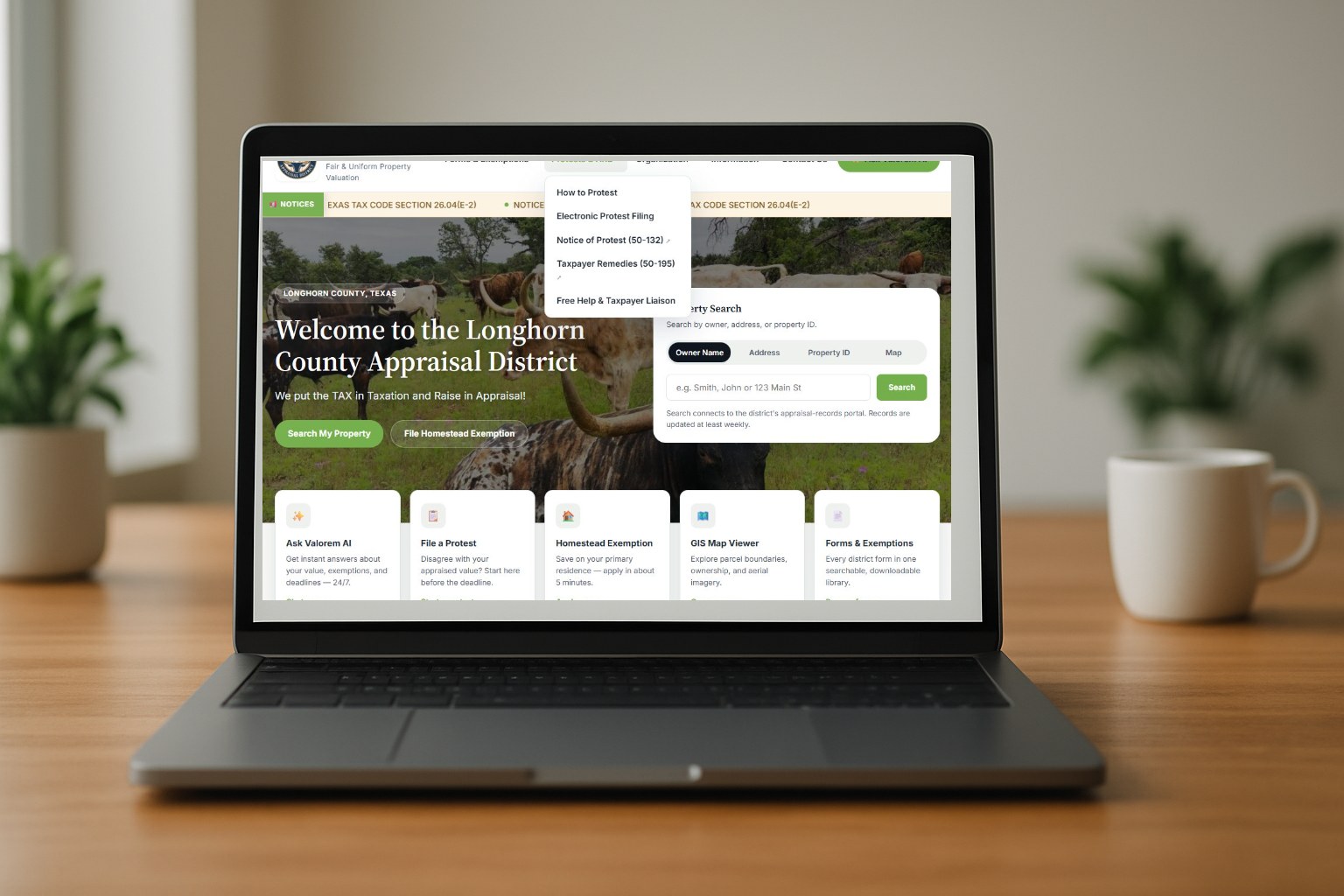
Your website is where taxpayers meet your district, so it is part of the service set: a visual page builder that publishes a real, compliant site, with an AI-powered importer to bring your current site across. Property search on the district's own site is coming soon, and the multilingual taxpayer assistant will sit on the same site. See a working district site at longhorncad.org, our standing demo.

01 / PLATFORM

The website platform

A multi-tenant CMS and public site built for appraisal districts, not a page builder borrowed from real-estate or restaurant templates.

  • Block-based Page Builder: drag sections to reorder them, with a live preview at desktop, tablet, and mobile sizes as you type
  • Data-driven blocks that stay current: notices, board members, staff, meetings, forms, and links all pull live from your records instead of being retyped as static text
  • Fourteen ready-made site designs and color themes to launch from, each restyling the whole site, and switching never touches your content
  • Protest, ARB, records, and employment pages written around how Texas ARB processes actually work
  • A Calendar carrying board and ARB meetings alongside deadlines, holidays, and office closures, plus Data Downloads, Abstracts & Subdivisions pages that update themselves as entries are added
  • Meta descriptions that fill themselves in from each page's content on save, and never overwrite anything you wrote yourself
  • A built-in Support Center with a guided setup tutorial, a searchable staff guide, and an "Ask the Docs" search for staff
Already have a site? We import it →
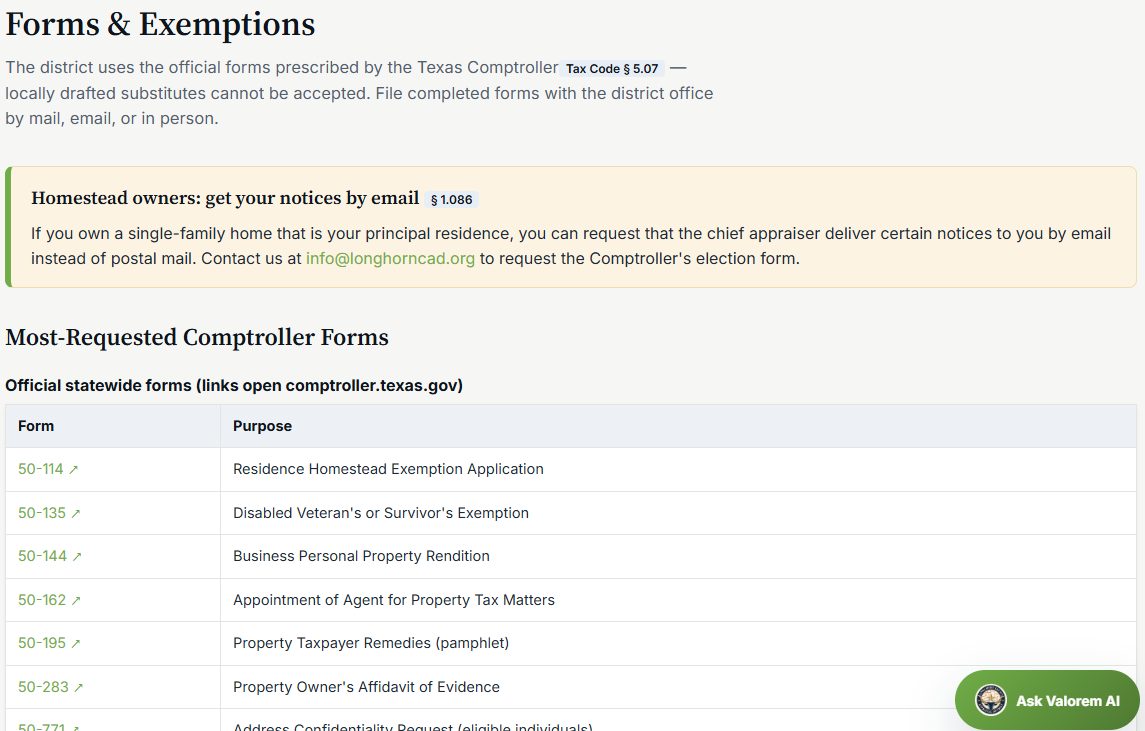
/forms
Forms and Exemptions page listing official Texas Comptroller property tax forms with statute citations

Already have a site?

We import it — you don't start from a blank page.

Point the importer at your current site's address and it does the first pass for you. Nobody on your staff has to retype years of board minutes and forms by hand. How the importer works.

  1. Scan. Give it your current site's address. It crawls every page it can reach, politely, honoring your site's robots rules for individual paths.
  2. Read. AI reads each page and sorts what it finds — board members, staff, meetings, forms, notices, and general pages.
  3. Review. Nothing is written until you approve it. Your team reviews what it found, page by page and category by category.
  4. Import in batches, and undo anytime. Approve one category at a time. Pages arrive as drafts for you to publish; board members, staff, meetings, forms, notices and links appear on your site when you approve their category. Change your mind? Any import can be undone by category, and undo targets only the records the importer itself created.
Laptop displaying the Longhorn County Appraisal District homepage, built on Valorem AI

Security

Built for the trust government AI has to earn.

Applicants' ID numbers, your CAMA, and your staff's accounts get the same protection whether your district has 8,000 parcels or 800,000.

1 AI and your data

  • Forms intake keeps confidential application fields on infrastructure your district controls, not in Valorem's cloud
  • Read-only CAMA access on a dedicated database login. Valorem never writes to CAMA tables
  • No model is trained on your forms. Reviewer corrections stay with your district as labeled data
  • Every value AI proposes is shown beside its source image, and a person approves it before import

2 Infrastructure

  • Hosted on Cloudflare's global network, with DDoS mitigation and a managed web application firewall in front of every request
  • Encrypted at rest and in transit, with TLS certificates issued and renewed automatically
  • Tenant isolation: one district's login can't see or reach another district's data
  • Cloudflare's own infrastructure is independently audited under SOC 2 Type II, ISO 27001, and PCI DSS

3 Access & accountability

  • Role-based access scoped to exactly what each staff account needs
  • Multi-factor authentication on admin sign-in through Microsoft or Cloudflare, set up for your district at go-live
  • Every content, account, and district-settings change is logged and reviewable in an audit log
  • District admins manage their own editor accounts, and safemode IT removes any departing employee's login on request, immediately

4 Website backups & recovery

  • Nightly backups of every page, record, form, image and document to separate, locked storage
  • Copies go to a separate backup bucket with deletion locks: 90 days on uploaded files, 30 days on each night's district export. 30 nightly copies are kept, plus one from the first of each month for the past year
  • Your district can be restored on its own, without affecting any other district on the platform
  • A site cannot be deleted on the spot by anyone, us included. It goes offline first and stays recoverable for 30 days, and the removal workflow has no shortcut
Nightly immutable backups Cloudflare-certified infrastructure Encrypted at rest & in transit Full tenant isolation MFA set up at go-live Complete audit trail A person approves every AI decision Read-only CAMA access

Who it's for

Built for the people who actually run a Texas appraisal district.

Not generic AI with a government label on it. Valorem AI is built around the day-to-day of a CAD's own staff and the residents who show up looking for a form or a deadline.

  • Chief appraisers who want AI taking work off their staff without handing it decisions the law reserves for people
  • IT staff who need AI that keeps confidential application data where the district controls it
  • Boards of directors who have to adopt an AI code of ethics and show the district's staff are trained
Illustrative photo of appraisal district staff working at their desks in a Texas county office

Getting started

From first conversation to AI doing real work.

01

Policy & training

We draft your district AI policy and the board resolution adopting DIR's code of ethics, and enroll the staff who need certified AI and cybersecurity training this year.

02

Forms intake

We start with agent appointments: read, matched to your CAMA read-only, and exported for import, with staff hours measured against the baseline you set.

03

Expand

Exemption forms come next, with a person approving each record. Then add the services that fit your district, from the website to the taxpayer assistant as it ships.

Questions

What districts usually ask first.

Does Valorem AI decide exemptions or values?

No. Every Valorem AI service reads, matches, answers or flags, and a person makes each decision. Exemption records always need staff approval one by one. That keeps the services out of SB 1964's heightened scrutiny category, which covers AI that makes or controls a decision about a person's access to a government service.

Where does confidential application data go?

Forms intake keeps the confidential fields on an exemption application, such as driver's license and Social Security numbers, on infrastructure your district controls, and reads your CAMA through a read-only login. Agricultural applications, confidential in full under § 23.45, take the same path. Valorem's cloud holds queue status and non-confidential fields.

Do we need an AI policy before using AI?

SB 1964 requires every Texas local government to adopt DIR's AI code of ethics, and a written policy is what tells staff which AI tools are approved. The AI training and compliance package includes both, along with the annual certified training HB 3512 requires.

Does Valorem AI include an AI assistant?

Not as a live product today. The AI in the website platform is the site importer, which reads your current website and drafts the migration for your team to review. A multilingual taxpayer assistant that answers deadline and status questions from your district's data and published pages is coming soon; a preview of the panel appears on the Longhorn demo. The AI services available now are forms intake, the AI training and compliance package, and the website platform.

Does Texas law actually require our appraisal district to have a website?

If your county's population is 120,000 or more, yes. Texas Tax Code § 6.17 requires it. Below that threshold it isn't mandated, but the other duties attach to whatever you do run: § 26.17's county tax database applies to every district, and §§ 25.025–25.027 restrict what you may post. That's why nearly every Texas CAD has a site regardless of size.

How is this different from a generic government-website builder?

Valorem AI is built around real Texas appraisal district workflows: protest filing, ARB procedures, the § 26.17 tax database, and Comptroller-form compliance. A generic city-website template leaves you to bolt all of that on yourself.

How long does it take to go live?

A few weeks from kickoff to launch, not months (see the steps above). Migrating your existing content used to be the biggest chunk of that time — now our importer reads and drafts most of it automatically, so more of that time goes to your team reviewing what it found and getting through branding.

How does the importer actually work?

You give it your current site's address. It crawls the pages it can reach, reads each one with AI, and sorts what it finds into board members, staff, meetings, forms, notices, and general pages. Nothing is written until your team approves a category (pages arrive as drafts; directory records go live on approval), and any import can be undone cleanly if you change your mind. Property-search portals are kept as links; the importer never touches parcel or tax data.

Does Valorem AI include property search?

Not yet. Property search that runs on the district's own site is coming soon: search by owner name, address, or property ID, with records loaded from your appraisal software's data. It is not live today. Until it ships, your site's search box links to the property-search portal you already use.

Is there a free trial?

A self-service free trial is coming soon, so you'll be able to spin up your own demo site without booking a call first. It's not live yet — until then, request a walkthrough and we'll set you up personally.

Is our district's data isolated from other districts on the platform?

Yes. Valorem AI is multi-tenant by design: every district's records, users, and files are walled off from every other district at the application level, on infrastructure independently audited under SOC 2 Type II and ISO 27001.

Who hosts the site, and what happens to our data?

Everything runs on Cloudflare's global network, encrypted at rest and in transit. Parcel, exemption, and appraisal records never enter the platform: your property-search portal stays a link, so protected home addresses and exemption-application documents stay in the system that already governs them.

Get started

Ready to put AI to work in your district?

Tell us about your district and we'll walk you through the services that fit it, starting with what is available today.

  • Forms intake and the AI training and compliance package are available now
  • Typical website kickoff-to-live timeline: a few weeks, not months
  • Our importer reads your current site and drafts the migration for your team to review
  • Confidential application data stays on infrastructure your district controls
  • A self-service free trial is coming soon — for now, request a walkthrough and we'll set you up personally
Existing district? Sign in →

Or email us directly at [email protected].